
Freelancers: 7 Essential Tips for Thriving in Your Career
Introduction :
Freelancing is no longer a side hustle — it is a full-fledged profession.
From graphic designers and content writers to IT consultants and digital marketers, thousands of professionals are working independently and earning across India and even globally.
But one question often creates confusion:
“Do freelancers need GST registration?”
The answer depends on turnover, type of services, and nature of clients.
Let’s break it down simply and clearly.
GST on Freelancers – Meaning and Applicability
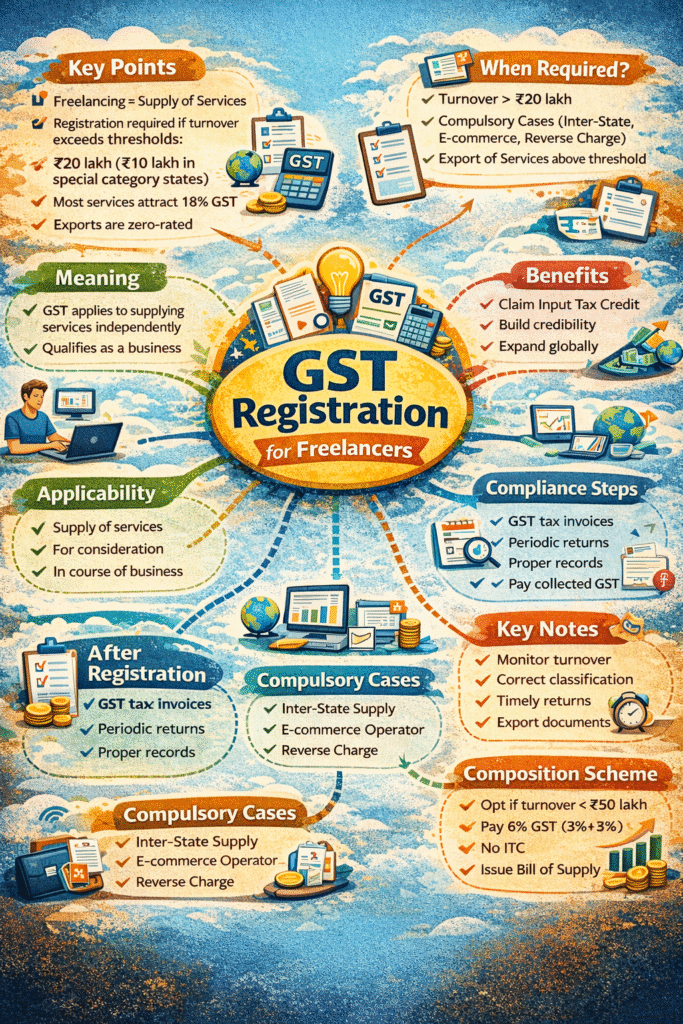
Under GST law, a freelancer providing services independently is considered a supplier of services.
As per Section 7 (Scope of Supply) and Section 9 (Levy and Collection) of the CGST Act, 2017, GST is applicable on supply of services for consideration in the course or furtherance of business.
Freelancing qualifies as:
✔ Supply of services
✔ For consideration (fees)
✔ In course of business
Therefore, freelancing services are taxable under GST — subject to registration threshold limits.
When Is GST Registration Mandatory for Freelancers?
1️⃣ Based on Turnover (Section 22 – Persons liable for registration)
As per Section 22 of the CGST Act, 2017:
A service provider must take GST registration if aggregate turnover exceeds:
- ₹20 lakh (in most States)
- ₹10 lakh (in Special Category States – Manipur, Mizoram, Nagaland and Tripura)
If your total receipts from freelancing cross this limit in a financial year, GST registration becomes mandatory.
If your turnover is below the threshold, GST registration is not compulsory (unless covered under compulsory registration provisions).
2️⃣ Compulsory Registration Cases (Section 24)
Under Section 24 of the CGST Act, 2017, registration is compulsory in certain cases, even if turnover is below ₹20 lakh.
Important cases relevant to freelancers:
✔ If you are making inter-State taxable supply of services
✔ If you are required to pay tax under reverse charge
✔ If you are supplying through an e-commerce operator (in certain cases)
However, inter-State service providers are allowed threshold exemption as per amendments and notifications. Hence, small freelancers providing inter-State services below ₹20 lakh are generally not required to register.
GST Rate Applicable to Freelancers
Most professional and consultancy services fall under:
18% GST (9% CGST + 9% SGST or 18% IGST)
This generally applies to:
- IT services
- Marketing services
- Consultancy
- Designing
- Writing services
- Professional advisory services
(Subject to specific classification)
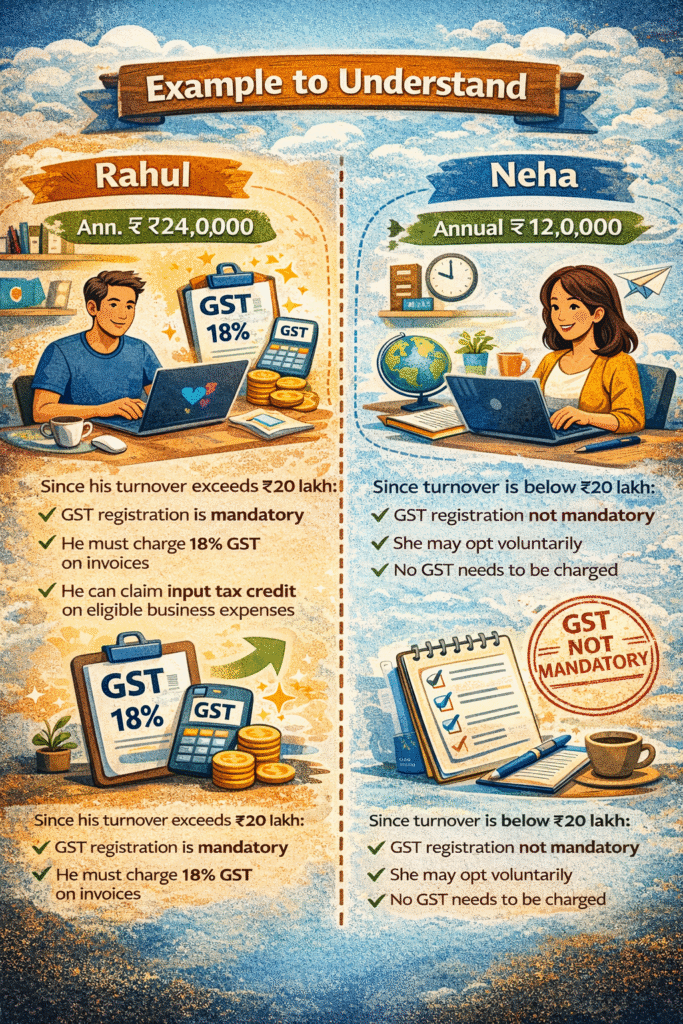
Example to Understand
Suppose:
Rahul is a freelance graphic designer.
- Annual receipts: ₹24,00,000
- Clients: Companies in India
Since his turnover exceeds ₹20 lakh:
✔ GST registration is mandatory
✔ He must charge 18% GST on invoices
✔ He can claim input tax credit on eligible business expenses
Another Scenario:
Neha is a freelance content writer.
- Annual receipts: ₹12,00,000
- Clients: Indian startups
Since turnover is below ₹20 lakh:
✔ GST registration not mandatory
✔ She may opt voluntarily
✔ No GST needs to be charged
What About Freelancers Working for Foreign Clients?
If a freelancer provides services to clients outside India and satisfies export conditions:
- It may qualify as Export of Services
- Exports are treated as Zero-rated supply
Meaning:
✔ GST not payable (subject to conditions)
✔ Refund of input tax credit may be available
However, registration may still be required if turnover exceeds threshold.
Composition Scheme – Can Freelancers Opt?
Service providers (other than certain notified categories) generally cannot opt for traditional composition meant for traders.
However, small service providers may opt for composition scheme under Section 10(2A).
Under Section 10(2A) of the CGST Act, 2017, eligible service providers opting for the composition scheme are required to pay tax at:
6% of turnover in the State / Union Territory
- 3% CGST + 3% SGST
- (Or 6% IGST in case of inter-State supplies, where applicable)
Key Conditions:
- Aggregate turnover in the preceding financial year should not exceed ₹50 lakh.
- No collection of GST from customers.
- No eligibility to claim Input Tax Credit (ITC).
- Must issue Bill of Supply instead of tax invoice.
This scheme is meant for small service providers to reduce compliance burden while paying tax at a concessional rate.
Benefits of GST Registration for Freelancers
Even if not mandatory, voluntary registration may help:
✔ Claim input tax credit on laptop, software, internet bills
✔ Work with larger corporate clients
✔ Build business credibility
✔ Handle export transactions smoothly
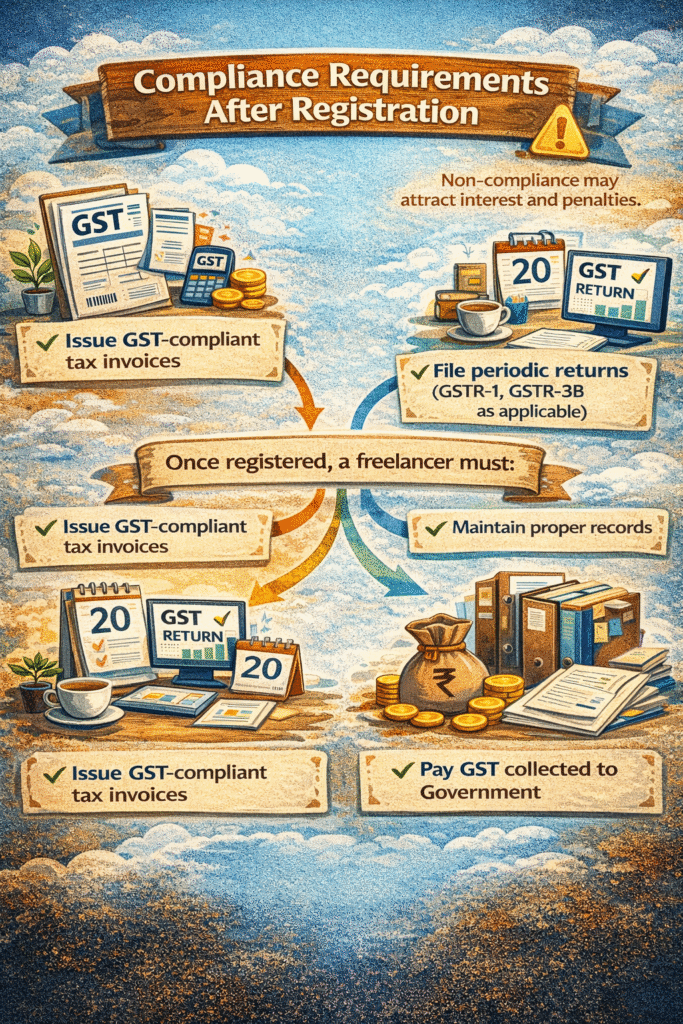
Compliance Requirements After Registration
Once registered, a freelancer must:
✔ Issue GST-compliant tax invoices
✔ File periodic returns (GSTR-1, GSTR-3B as applicable)
✔ Maintain proper records
✔ Pay GST collected to Government
Non-compliance may attract interest and penalties.
Points to Be Careful About
⚠️ Monitor turnover regularly
⚠️ Correct classification of services
⚠️ Timely return filing
⚠️ Proper documentation for export benefits
⚠️ Avoid charging GST without registration
Proper planning avoids notices and penalties.
GST Registration – Quick Decision Table
| Situation | GST Registration Required? |
|---|---|
| Turnover below ₹20 lakh | No (generally) |
| Turnover above ₹20 lakh | Yes |
| Export of services above threshold | Yes |
| Voluntary registration | Optional |
| Compulsory category under Section 24 | Yes |
GST on Freelancers vs Salary Income
Important distinction:
✔ Freelancer → Business income → GST may apply
✔ Salaried employee → Employer-employee relationship → Not treated as supply → No GST
Why This Matters for Freelancers
Many freelancers ignore GST until they receive notices.
Understanding GST helps:
👉 Avoid penalties
👉 Price services correctly
👉 Work confidently with large clients
👉 Expand globally
GST compliance is not a burden — it is a business discipline.
Key Takeaways
- Freelancers are treated as suppliers of services under GST.
- Registration is required if turnover exceeds ₹20 lakh (₹10 lakh in special category states).
- Most freelancing services attract 18% GST.
- Export of services is zero-rated.
- Proper compliance ensures smooth business operations.
Final Thought
Freelancing gives you freedom — but with freedom comes responsibility.
Understanding GST ensures you grow your independent career without legal hurdles.
👉 Track your turnover.
👉 Know your registration requirement.
👉 Stay compliant.
Smart compliance builds strong business foundations.
ALSO READ: Akhil Krishan Maggu vs. Deputy Director (2019)
Is GST registration mandatory for all freelancers?
No. GST registration is required only if aggregate turnover exceeds ₹20 lakh (₹10 lakh in specified special category States) or if covered under compulsory registration provisions under Section 24 of the CGST Act, 2017.
What GST rate is applicable to freelancing services?
Most professional and consultancy services provided by freelancers attract 18% GST (9% CGST + 9% SGST or 18% IGST), subject to proper classification.
Is GST payable on services provided to foreign clients?
If conditions of export of services are satisfied, such services qualify as zero-rated supply, and GST is not payable (subject to conditions), with eligibility to claim refund of input tax credit.
Can freelancers opt for the Composition Scheme?
Yes, eligible small service providers with turnover up to ₹50 lakh in the preceding financial year may opt under Section 10(2A) and pay GST at 6%, subject to prescribed conditions.
Leave A Comment