Capital Gain Taxation: 7 Essential Insights You Need
We invest in shares and mutual funds for one reason:
To build wealth.
Markets rise. NAVs grow. Portfolios expand.
But one critical question arises when you redeem or sell:
How much tax will you pay on the profit?
Because when you sell shares or mutual funds, the profit is taxable under the head “Capital Gains.”
Understanding the rules can significantly improve what you ultimately retain.
Let’s simplify it.
What Is Capital Gain in Shares & Mutual Funds?
When you sell:
Sale Value
– Cost of Acquisition
– Expenses (like brokerage, STT not deductible)
= Capital Gain
This gain is taxable under the Income-tax Act, 1961.
But the tax depends mainly on:
✔️ Type of asset
✔️ Holding period
✔️ Whether Securities Transaction Tax (STT) is paid
✔️ Type of mutual fund
And this is where many investors get confused.
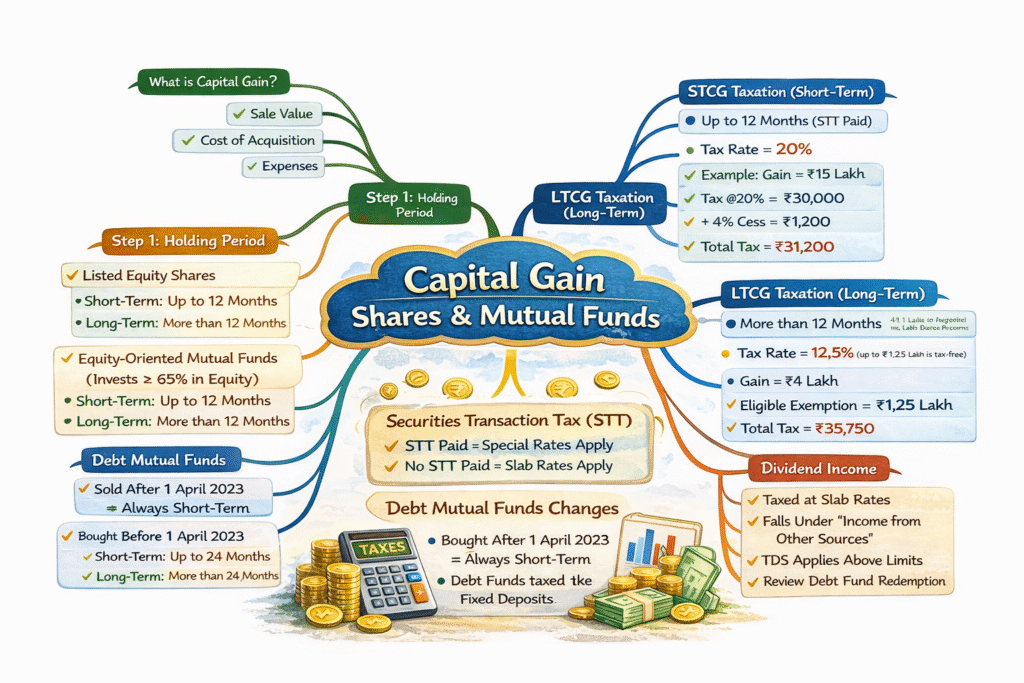
Step 1: Holding Period – The Most Important Factor
1️⃣ Listed Equity Shares (STT Paid)
Held for 12 months or less → Short-Term
Held for more than 12 months → Long-Term
Note: For unlisted equity shares the time limit is 24 months.
2️⃣ Equity-Oriented Mutual Funds
(Schemes investing ≥ 65% in equity)
Held for 12 months or less → Short-Term
Held for more than 12 months → Long-Term
3️⃣ Debt Mutual Funds
The rules depend on date of purchase.
If purchased on or after 1 April 2023:
- Gains are taxed as short-term, regardless of holding period.
- Taxed at normal slab rate
- No indexation benefit
If purchased before 1 April 2023:
- Held up to 24 months → Short-Term
- Held more than 24 months → Long-Term
Long-term gains eligible for 12.5% without indexation or 20% with indexation (subject to conditions under recent amendments).
Short-Term Capital Gain (STCG) – Shares & Equity Funds
If listed equity shares or equity mutual funds are sold within 12 months and STT is paid:
Tax Rate = 20%
(As amended by Finance Act, 2024)
Plus 4% Health & Education Cess
Plus surcharge, if applicable
Example – Short-Term Equity Sale
You bought shares for ₹5 lakh.
You sell them after 8 months for ₹6.5 lakh.
Gain = ₹1.5 lakh
Tax @20% = ₹30,000
Cess @4% = ₹1,200
Total Tax = ₹31,200
Flat rate. No slab benefit.
Long-Term Capital Gain (LTCG) – Shares & Equity Funds
If listed equity shares or equity-oriented mutual funds are held for more than 12 months:
Tax Rate = 12.5%
✔️ Without indexation
✔️ Exemption up to ₹1.25 lakh per year
Only gain exceeding ₹1.25 lakh is taxable.
Plus 4% cess.
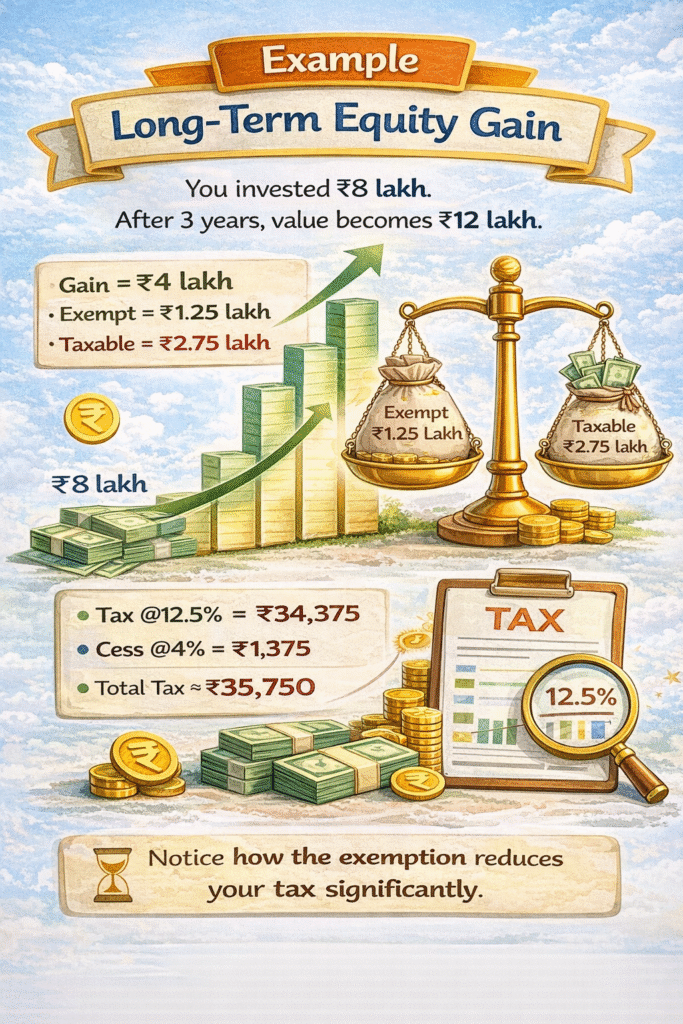
Example – Long-Term Equity Gain
You invested ₹8 lakh.
After 3 years, value becomes ₹12 lakh.
Gain = ₹4 lakh
Exempt = ₹1.25 lakh
Taxable = ₹2.75 lakh
Tax @12.5% = ₹34,375
Cess @4% = ₹1,375
Total Tax ≈ ₹35,750
Notice how the exemption reduces your tax significantly.
What About Securities Transaction Tax (STT)?
For special rates to apply:
✔️ Securities Transaction Tax (STT) must be paid
✔️ Sale must be through recognized stock exchange
Otherwise, normal capital gain provisions may apply.
Debt Mutual Funds – The Big Change
This is where many investors get surprised.
For Units Purchased After 1 April 2023:
Regardless of holding period:
✔️ Taxed at slab rate
✔️ No long-term benefit
✔️ No indexation
So if you are in 30% slab → Gain taxed at 30%
This makes debt funds similar to fixed deposits from a tax perspective.
Indexation – When Available
For eligible long-term non-equity units (acquired before cut-off dates), taxpayers may opt:
✔️ 12.5% without indexation
OR
✔️ 20% with indexation (subject to transitional provisions)
Indexation adjusts cost for inflation and may significantly reduce taxable gain.
Always compute both options.
Capital Loss Rules
Very important for portfolio management.
Short-Term Capital Loss
Can be set off against:
✔️ Short-term gains
✔️ Long-term gains
Long-Term Capital Loss
Can be set off only against:
✔️ Long-term gains
Unadjusted loss can be carried forward for 8 years.
But only if return is filed within due date.
Dividend Income – Separate Treatment
Dividends from shares and mutual funds:
✔️ Taxed under “Income from Other Sources”
✔️ Taxed at slab rate
✔️ TDS applicable above prescribed limits
No longer tax-free in investor’s hands.
Special Situations Investors Miss
❌ Switching between mutual fund schemes – treated as sale
❌ STP transfers – each transfer is taxable
❌ Bonus shares – cost allocation matters
❌ Rights shares – separate cost computation
❌ ESOP sales – separate tax considerations
Every transaction matters.
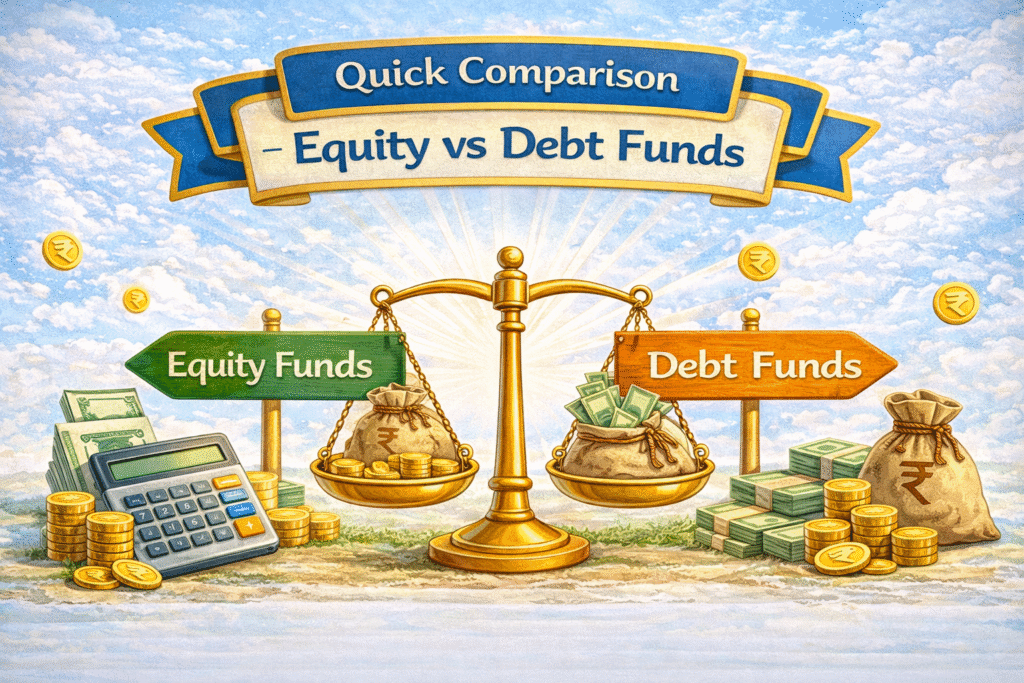
Quick Comparison – Equity vs Debt Funds
| Basis | Equity Shares / Equity MF | Debt Mutual Funds (Post 1 April 2023) |
|---|---|---|
| Short-Term Period | 12 months | Always STCG |
| LTCG Rate | 12.5% | Not available |
| Exemption | ₹1.25 lakh | Not available |
| Slab Taxation | No | Yes |
| Indexation | No | No |
Smart Tax Planning Tips
✔️ Hold equity investments beyond 12 months
✔️ Use ₹1.25 lakh LTCG exemption every year (tax harvesting)
✔️ Harvest losses to offset gains
✔️ Track purchase dates carefully
✔️ Review debt fund purchase date before redemption
✔️ File returns on time to preserve losses
Tax planning is not timing the market.
It is timing your exit wisely.
Why This Matters
Imagine selling shares at 11 months vs 13 months.
That small difference:
Could reduce your tax rate
Could give you exemption benefit
Could save lakhs
Capital gain taxation is not complicated.
It is about:
✔️ Holding period
✔️ Type of asset
✔️ Applicable rate
✔️ Available exemption
When you plan your exit as carefully as your entry,
you maximize wealth retention.
Final Thought
Investing grows your money.
Tax awareness protects it.
Because at the end of the day —
It’s not just what your portfolio earns.
It’s what you keep after tax.
ALSO READ: CIT (LTU) v. Reliance Industries Ltd (2024)
Do I have to pay tax if I reinvest the money in another mutual fund?
Yes. Switching or reinvesting is treated as a sale for tax purposes. Capital gains tax applies even if the amount is immediately reinvested.
Is the ₹1.25 lakh LTCG exemption automatic?
Yes, for eligible listed equity shares and equity mutual funds held over 12 months. Only gains exceeding ₹1.25 lakh in a financial year are taxable at 12.5%.
Can capital losses reduce my overall tax liability?
Yes. Short-term losses can be set off against both STCG and LTCG, while long-term losses can be set off only against LTCG. Unused losses can be carried forward for 8 years.
Are dividends from shares and mutual funds tax-free?
No. Dividends are taxable under “Income from Other Sources” at your slab rate, and TDS may apply above prescribed limits.
Leave A Comment