
Tax Harvesting – 5 Joyful Insights for Successful Investing
Introduction :
Tax season often brings a bit of dread, but what if you could turn your investment losses into a strategic advantage?
Tax harvesting is the secret weapon of savvy investors. Think of it as finding a silver lining in a market dip—repurposing a loss today to protect your wealth tomorrow.
In simple terms, tax harvesting means smartly selling investments at the right time to either:
- Use tax-free limits on gains, or
- Book losses to reduce taxable profits.
It is commonly used for equity shares, mutual funds, and securities, especially towards the end of the financial year as part of tax planning.
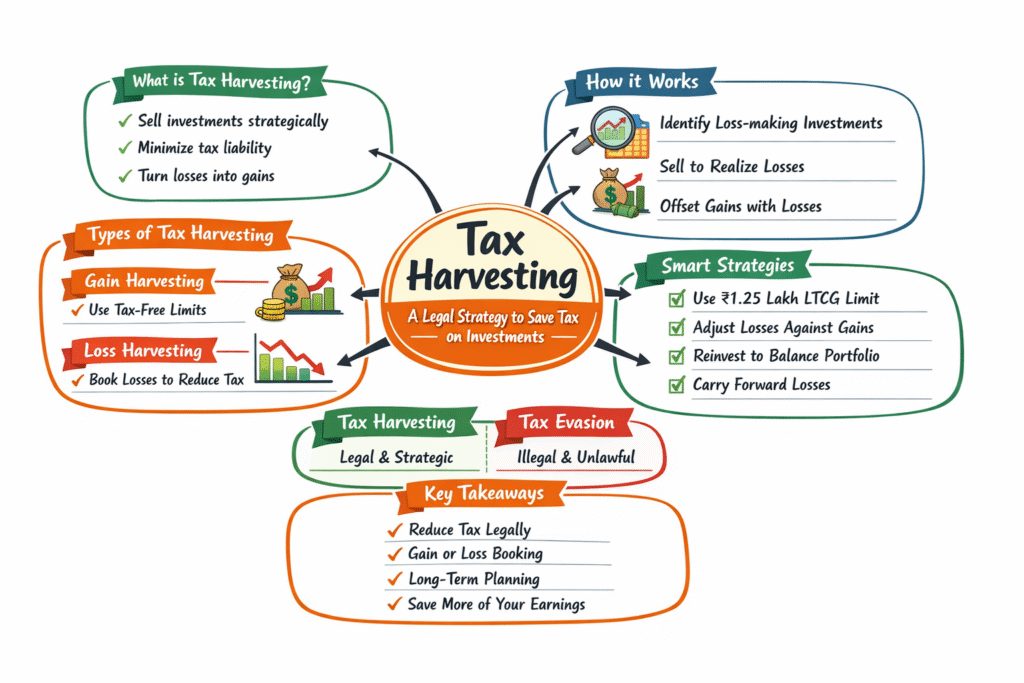
Tax Harvesting – Meaning and How it Works?
Tax harvesting is a planned approach to buying and selling investments so that your tax liability is minimized without disturbing your long-term investment goals.
You may:
- Sell investments to book gains up to the tax-free limit, or
- Sell loss-making investments to offset gains and reduce tax
At its core, it is a simple three-step process. First, you identify “underwater” investments in your taxable accounts—those currently worth less than what you paid for them. Second, you sell those assets to “realize” the capital loss. Finally, you use that loss to cancel out capital gains you’ve made elsewhere in your portfolio.
The best part? You can reinvest the money again, keeping your portfolio almost unchanged.
Why Do Investors Use Tax Harvesting?
Because it helps them:
- Pay less tax legally
- Improve overall returns after tax
- Use unused exemption limits
- Manage gains and losses wisely
Instead of reacting to tax, investors plan their sales strategically.
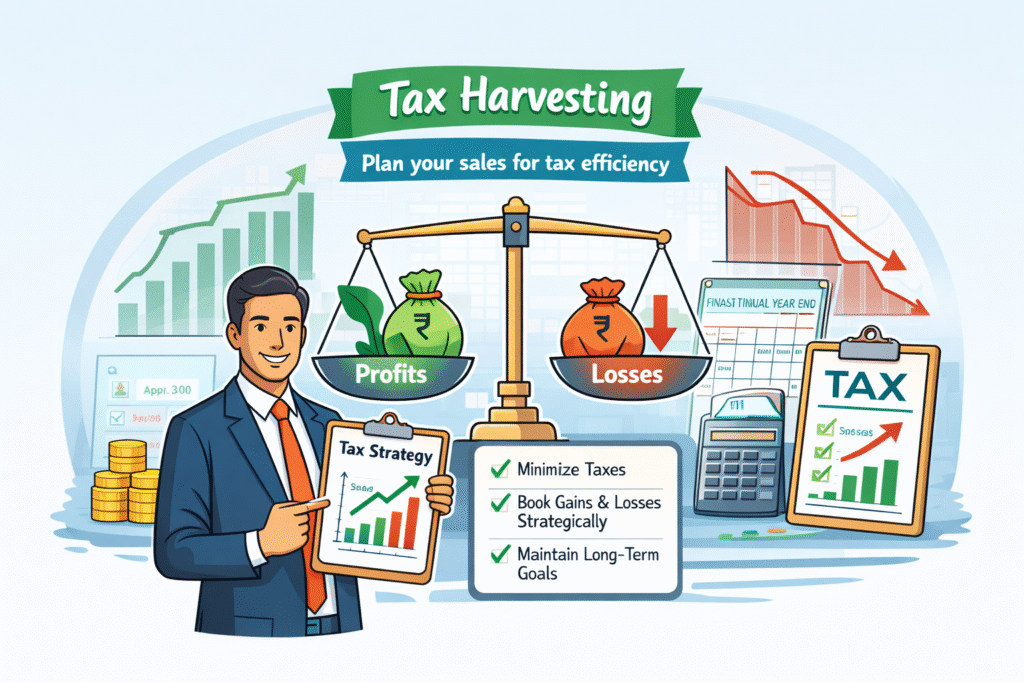
Types of Tax Harvesting
1️⃣ Gain Harvesting (Booking Profits Smartly)
Here, investors sell investments that are in profit to use available tax-free limits.
Example:
Long-term capital gains (LTCG) on listed equity up to ₹1.25 lakh are tax-free.
So, if your profit is ₹1,15,000, you can sell shares, enjoy tax-free gains, and buy them again — zero tax, same investment.
2️⃣ Loss Harvesting (Using Losses to Save Tax)
Sometimes markets fall, and investments show losses. Instead of ignoring them, investors may sell such investments to book capital losses, which can reduce taxable gains in the same year or future years.
This turns a temporary loss into a tax-saving opportunity.
How the Law Supports Tax Harvesting
Tax harvesting works within the legal framework of capital gains taxation under the Income-tax Act.
The law allows:
- Adjustment of losses against gains
- Carry forward of losses for future years
- Exemption for small long-term gains
Hence, it is tax planning — not tax avoidance.
Simple Example to Understand
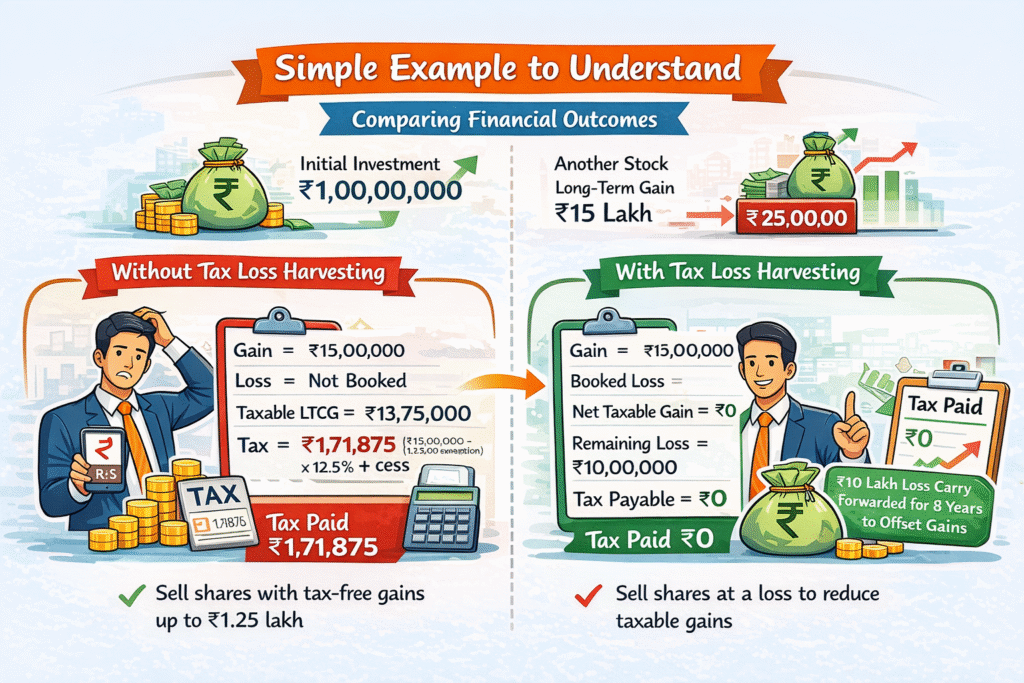
Suppose you invested ₹1,00,00,000 in equity shares. After a market dip, the value falls to ₹75,00,000, resulting in an unrealised loss of ₹25,00,000.
At the same time, you sold another stock and earned a long-term capital gain (LTCG) of ₹15,00,000.
Without Tax Loss Harvesting
- Gain = ₹15,00,000
- Loss = Not booked (still unrealised)
- Taxable LTCG = ₹15,00,000 – ₹1,25,000 exemption = ₹13,75,000
- Tax @12.5% = ₹1,71,875 (plus 4% Health and Education cess)
With Tax Loss Harvesting
You sell the loss-making shares and book the ₹25,00,000 loss, then reinvest in similar stocks to stay invested.
- Gain = ₹15,00,000
- Booked Loss = ₹25,00,000
- Net Taxable Gain = ₹0
- Remaining Loss to Carry Forward = ₹10,00,000
- Tax Payable = ₹0
By harvesting the loss, you save ₹1,71,875 tax today and also carry forward ₹10 lakh loss for up to 8 years to offset future capital gains — turning a temporary market fall into long-term tax efficiency.
Smart Strategies Used in Tax Harvesting
✔️ Use the ₹1.25 lakh LTCG exemption every year
✔️ Adjust losses against gains to reduce tax
✔️ Rebalance portfolio while saving tax
✔️ Utilize unused basic exemption slab if income is low
It is not about frequent trading, but about thoughtful planning.
Point to be Noted: ₹1.25 lakh exemption applies only to listed equity shares & equity mutual funds (not debt funds, property, gold etc.)
Benefits of Tax Harvesting
- Reduces tax burden legally
- Improves long-term investment returns
- Helps in better portfolio management
- Encourages disciplined financial planning
It ensures you keep more of what you earn.
Points to Be Careful About
- Transaction costs should not outweigh tax savings
- Avoid emotional decisions driven only by tax
- Market timing risks while re-entering investments
- Requires proper tracking of gains and losses
So, tax harvesting should be done carefully and thoughtfully.
Tax Harvesting vs Tax Evasion
Tax harvesting is often misunderstood. It is important to know the difference:
| Basis | Tax Harvesting | Tax Evasion |
|---|---|---|
| Nature | Legal tax planning | Illegal activity |
| Method | Strategic booking of gains/losses | Concealing income |
| Goal | Reduce tax burden smartly | Avoid tax unlawfully |
Thus, tax harvesting is a smart and compliant financial strategy.
Practical Relevance for Investors
Today, with growing investments in stock markets and mutual funds, tax harvesting has become essential.
It is especially useful:
- At financial year-end planning
- For investors with large equity portfolios
- For salaried individuals with investment income
It helps investors balance returns and taxes together.
Why Tax Harvesting Matters
In investing, earning returns is important — but retaining those returns after tax is equally crucial. Tax harvesting ensures that investors do not lose unnecessary money to taxes simply due to lack of planning.
It promotes a smarter mindset:
👉 Invest wisely, sell strategically, and save tax legally.
This makes tax harvesting not just a tax concept, but a holistic financial planning tool for modern investors SEO Meta Details
Key Takeaways
- Tax harvesting is a legal way to reduce tax on investments.
- It involves strategic booking of gains or losses.
- Gain harvesting uses tax-free limits efficiently.
- Loss harvesting helps offset profits and save tax.
- It is a long-term disciplined tax planning approach, not a quick trick.
ALSO READ: Sanjay Kumar. v. ACIT (IT) (2024)
Is tax harvesting legal in India?
Yes, tax harvesting is a completely legal tax planning method permitted under capital gains provisions of the Income-tax Act.
Can I reinvest immediately after booking a loss?
Yes, you can reinvest the proceeds to maintain your portfolio while still claiming the booked capital loss.
Is tax harvesting useful only at year-end?
No, it can be done anytime during the year, though many investors review it before financial year-end for effective tax planning.
Leave A Comment