
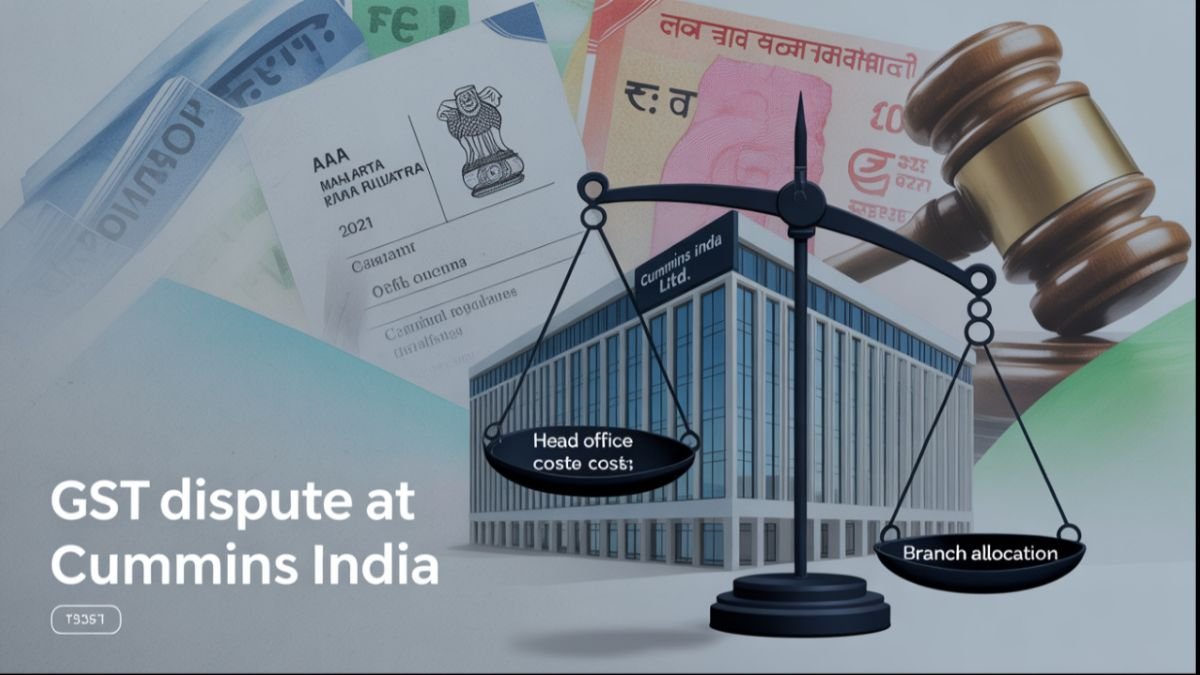
Cummins India GST Case: Under GST law, different registrations of the same legal entity across states are treated as distinct persons (Section 25(4), CGST Act). This principle has given rise to disputes about whether Head Office (HO) cost allocations to branches amount to “supply” under GST.
In In Re: Cummins India Ltd. [TS-747-AAAR (MAH)-2021, AAAR Maharashtra], the key issue was whether the allocation of common input service costs and employee salary costs by the HO to its branches constituted a taxable supply.
Cummins India, a multinational company with units across multiple states, procured common input services at its HO in Maharashtra. These costs were booked at the HO and then proportionately allocated to branches for profitability tracking. The main question: Does such internal allocation attract GST?
Facts of the Cummins India GST Case
- Assessee: M/s Cummins India Ltd., operating in multiple states.
- Process:
- HO in Maharashtra procured common input services (consultancy, audit, software, etc.).
- GST paid on such services was availed as ITC at HO.
- HO allocated the costs proportionately to branches as part of internal accounting.
- Dispute:
- Whether allocation of such costs (including HO employee salaries) is a taxable supply under GST.
- Whether obtaining ISD (Input Service Distributor) registration is optional or mandatory.
AAR Maharashtra Ruling
- Held that allocation of HO costs to branches amounts to supply of service under Section 7.
- ISD registration is mandatory to distribute ITC of common input services.
- The assessee appealed before the AAAR Maharashtra.
Points of Dispute
- Does allocation of common input service costs by HO to branches qualify as supply under GST?
- Does allocation of employee salary cost by HO to branches attract GST?
- Is ISD registration mandatory for distributing ITC, or optional at the assessee’s discretion?
Submissions by the Assessee
- ISD registration not compulsory: Section 24 of the CGST Act requires ISD registration only if the company chooses to distribute ITC. It is a facilitative mechanism, not a mandate.
- Employer-employee relationship: Employees work for the company as a whole, not just HO or branches. Salary costs should not be taxable.
- Internal allocation is not supply: Cost allocation is merely an internal accounting adjustment, not a taxable transaction.
Findings of the AAAR (Maharashtra)
The Appellate Authority upheld the AAR’s ruling against the assessee.
- Allocation of HO costs = supply:
- GST law defines “services” broadly to include all activities other than goods, money, and securities.
- HO procuring common services for branches is facilitation of services.
- Allocation and recovery of such costs qualify as taxable supply under Section 7(1)(a).
- ISD registration mandatory:
- Any HO receiving common input services on behalf of branches must register as an ISD if it intends to distribute ITC.
- HO cannot avail and utilize ITC on services consumed by branches.
- Employee salary cost allocation also taxable:
- HO employees support branch operations. Their costs are part of facilitation services to branches.
- Recovery of salary costs from branches is taxable under GST.
- Valuation of supply:
- As per Rule 28(c), value of supply between distinct persons can be based on invoice value, deemed as open market value if the recipient is eligible for full ITC.
Held:
- Allocation of HO costs, including employee salaries, to branches = taxable supply.
- ISD registration is mandatory for distribution of ITC of common input services.
- Value of supply to be determined as per Rule 28(c).
Practical Impact on Businesses
- HO–Branch transactions taxable: Internal allocations fall within GST scope.
- ISD registration compulsory: Companies must establish ISD for common input service ITC distribution.
- Employee salary cost taxable: HO employee cost recoveries allocated to branches attract GST.
- Higher compliance burden: More documentation, invoicing, and reporting required for inter-unit allocations.
- Industry impact: Significant for IT, pharma, MNCs, shared service centers, and multi-location manufacturers.
Key Takeaways
- HO-to-Branch allocations are treated as supply under GST, even without profit.
- Employee salary costs allocated to branches are taxable if linked to inter-unit services.
- ISD registration is mandatory, not optional, for common input service distribution.
- Businesses must carefully align accounting and GST treatment of internal allocations.
Why This Case Matters
The Cummins India ruling has far-reaching consequences for multi-state organizations. It reinforces that the distinct persons principle under GST applies strictly, and internal HO–Branch transactions can trigger GST liability.
It also highlights that HO employee support functions are not exempt when linked to services provided to branches. For businesses, this ruling necessitates a review of shared service models, cost allocation practices, and ISD registrations to ensure compliance with GST law.
Leave A Comment